
harles

ShieldONE
Role
Product Designer
Project Type
AI Assisted Project
Industry
Fintech/Digital Banking
Year
Completed 2026
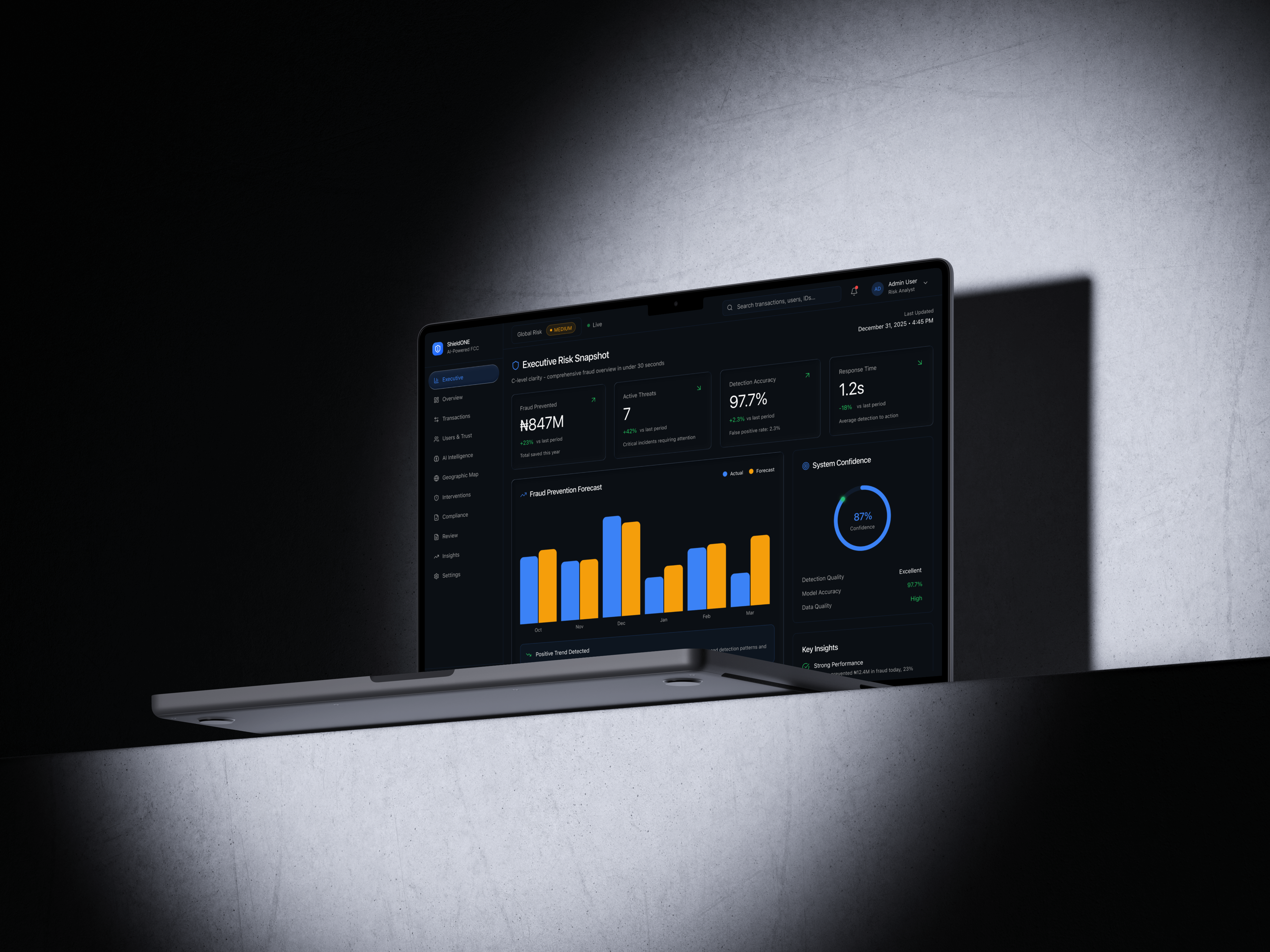
ShieldONE was designed as an enterprise-grade, desktop-first web application created to help fintech companies detect, predict, and prevent fraud before financial losses occur. Our design team worked closely to build a unified platform that could serve as a single source of truth for fraud, trust, risk, and compliance teams. The goal was to combine AI-driven intelligence with clear explainability and human oversight, enabling organizations to monitor threats and act decisively in real time.
In building this platform, we focused on the needs of fintech founders, executives, fraud analysts, risk and compliance teams, and payment operations managers. The experience was designed to give them immediate visibility into system health, emerging threats, and the impact of their interventions, enabling faster, more confident decision-making in high-stakes environments.The project was delivered through a collaborative effort between two product designers, a product manager, and the engineering team.

The part I played
My role
I worked as the lead product designer on ShieldONE, responsible for:
- From foundation to final UX and UI design
- Information architecture and dashboard structure
- Cross-functional collaboration with product, engineering, and risk stakeholders
- Designing AI explainability patterns and human-in-the-loop workflows
- Leveraging AI-assisted design tools to accelerate ideation and execution
The problem
As our team explored the problem space while working on ShieldONE, it quickly became clear that fraud detection in many fintech systems is still largely reactive. Through collaborative discovery sessions with the product manager, engineering team, and stakeholders, we uncovered a recurring pattern: by the time suspicious activity is reviewed, the money has often already left the system. This meant that many teams were operating in damage-control mode rather than actively preventing fraud.
During research and internal discussions, I also identified how fragmented the existing workflows were. Fraud and risk teams frequently had to switch between multiple tools, dashboards, and reports just to piece together a single incident. Together with the PM and engineering team, I mapped these workflows and saw how this fragmentation slowed response times, increased false positives, and created unnecessary friction for legitimate users.
Another major challenge was trust. Limited AI explainability made it difficult for teams to understand or confidently act on automated decisions. High-risk incidents took too long to resolve, false positives disrupted real customers, and compliance reporting was often manual, time-consuming, and stressful especially during audits.
These challenges highlighted the need for a single, proactive system that could bring visibility, speed, and trust back into fraud prevention workflows.
The goal
When defining the design goal for ShieldONE, I set out to create a real-time, AI-powered command center that could stop fraud before transactions were completed-not after the damage was done. I wanted every AI-driven decision to be clear and explainable, so teams could understand why something was flagged and act with confidence.
My focus was on enabling fast, decisive human intervention without overwhelming users with complexity. At the same time, the system needed to support regulatory readiness at all times, reducing the stress and overhead of compliance.
Finally, I designed the experience to give executives instant, high-level clarity so they could quickly understand system health, emerging risks, and the impact of decisions without diving into operational details.
ShieldONE
AI-Powered FCC

AI-assisted design workflow
AI support
A core part of my approach on ShieldONE was intentionally using AI to accelerate and strengthen the design process. As team lead, I treated AI as a design multiplier helping us explore more ideas, test assumptions faster, and make more informed decisions throughout the product development cycle.
Through prompt-driven ideation, I rapidly explored dashboard layouts, information hierarchies, and data visualization concepts, generating early concepts and iterating quickly before committing to a direction. I also used AI to refine copy and microcopy for clarity across complex workflows.
Beyond visuals, I leveraged AI to simulate scenarios and stress-test edge cases, allowing me to move faster from concept to validation and focus more on system thinking, UX quality, and decision-making without compromising design standards.
Initial AI Concepts(Scroll to explore)
Design process
Design direction
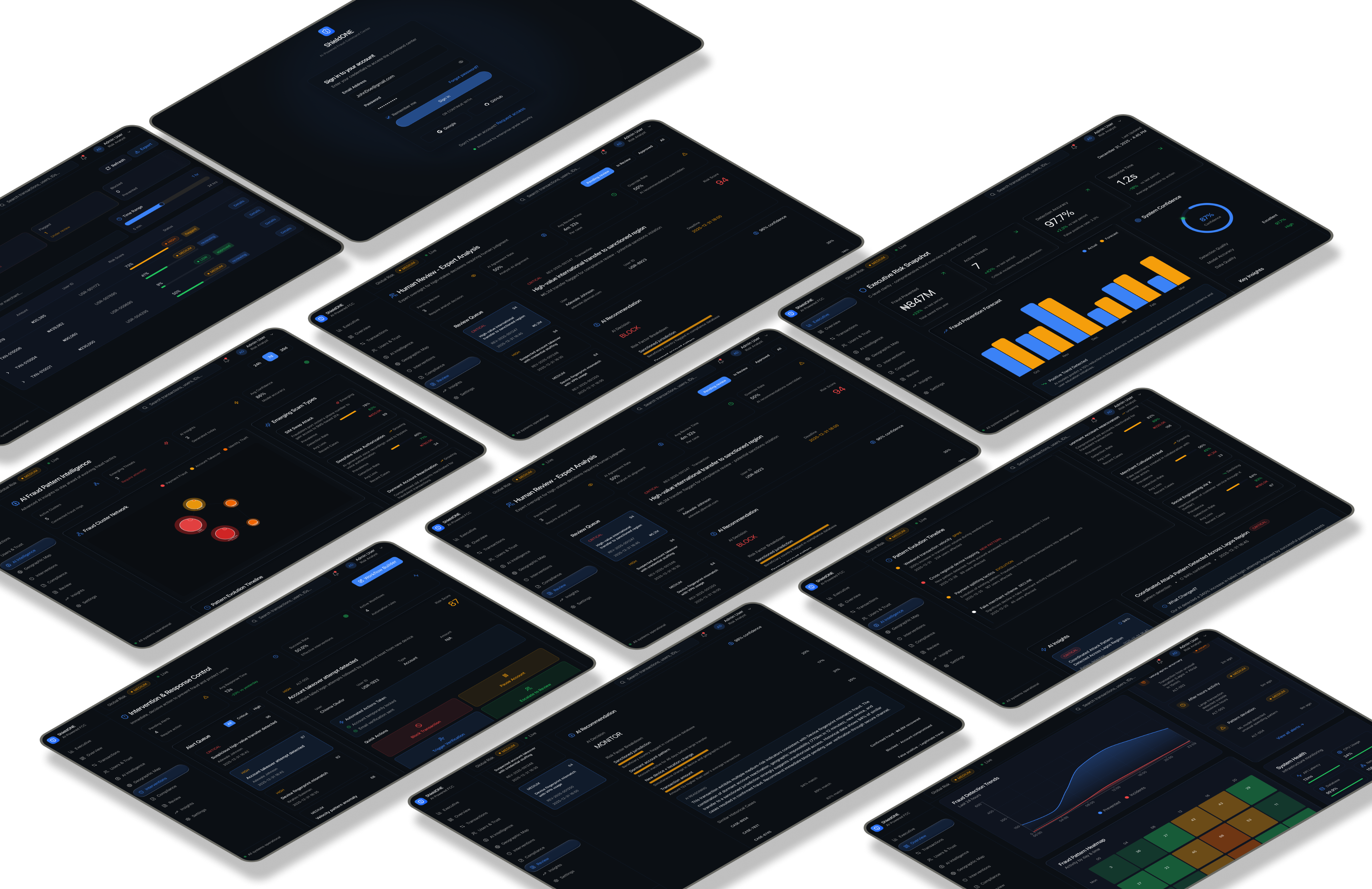
I began by mapping the full fraud lifecycle, from transaction initiation to post-incident reporting, and speaking with stakeholders to understand how different teams think and work. Executives needed clarity without noise, analysts needed depth and control, and compliance teams needed traceability and audit-ready outputs.
These insights led me to design ShieldONE as a multi-layered system rather than a single dashboard. I created role-based views ranging from a high-level command center to live risk monitoring, human-in-the-loop reviews, and compliance reporting while maintaining a shared data foundation. Throughout, I focused on balancing dense real-time data with clarity and scannability to support fast, confident decisions.

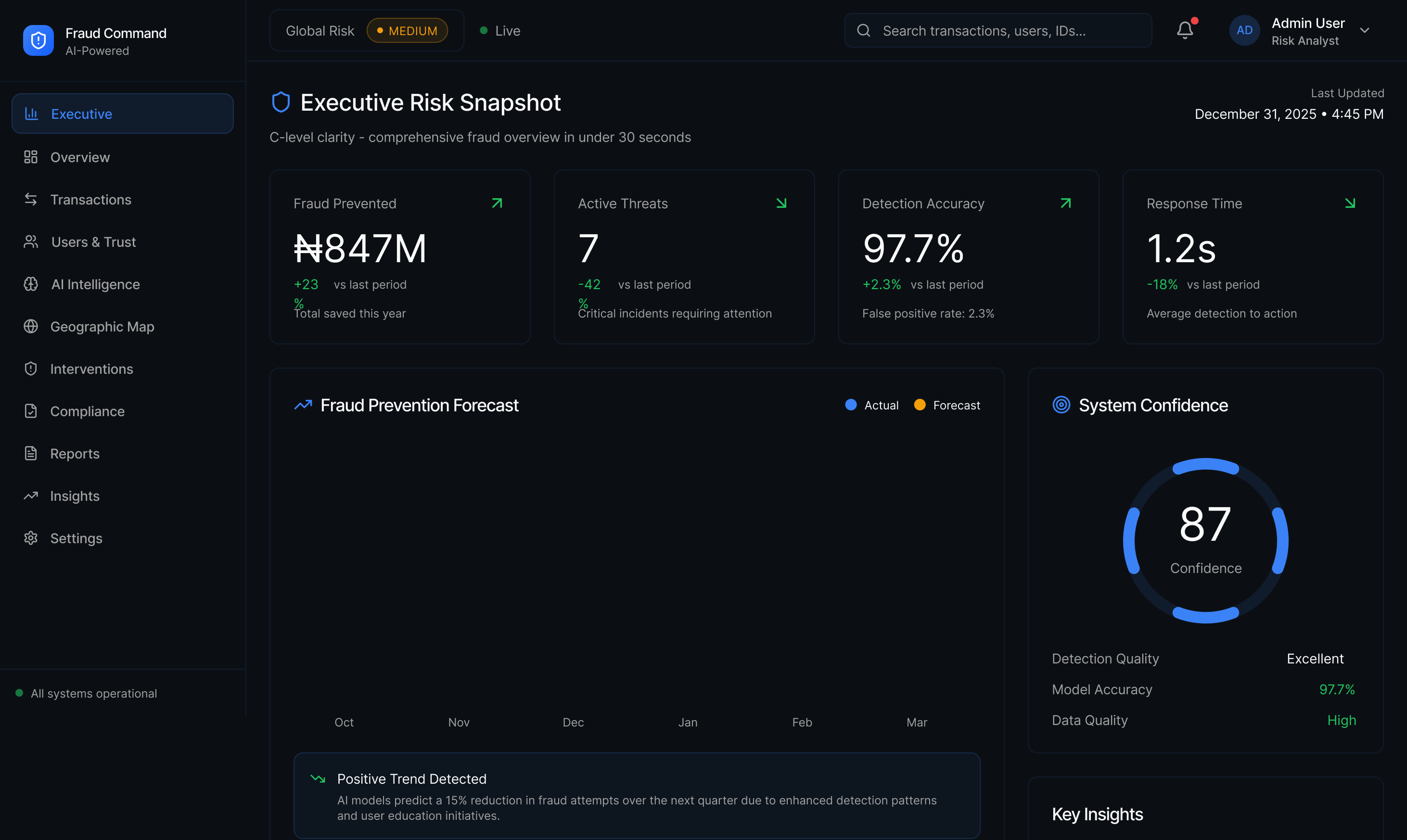
Executive Snapshot
✔ KPI cards: High-impact KPI cards (fraud prevented, active risks, response time, confidence index)
✔ Fraud forecast: Compare actual and forecasted fraud prevented
✔ Confidence score: System confidence score for fraud detection, accuracy and data quality.
✔ Key insights: Insights on performance, number of threats, compliance and trend direction.
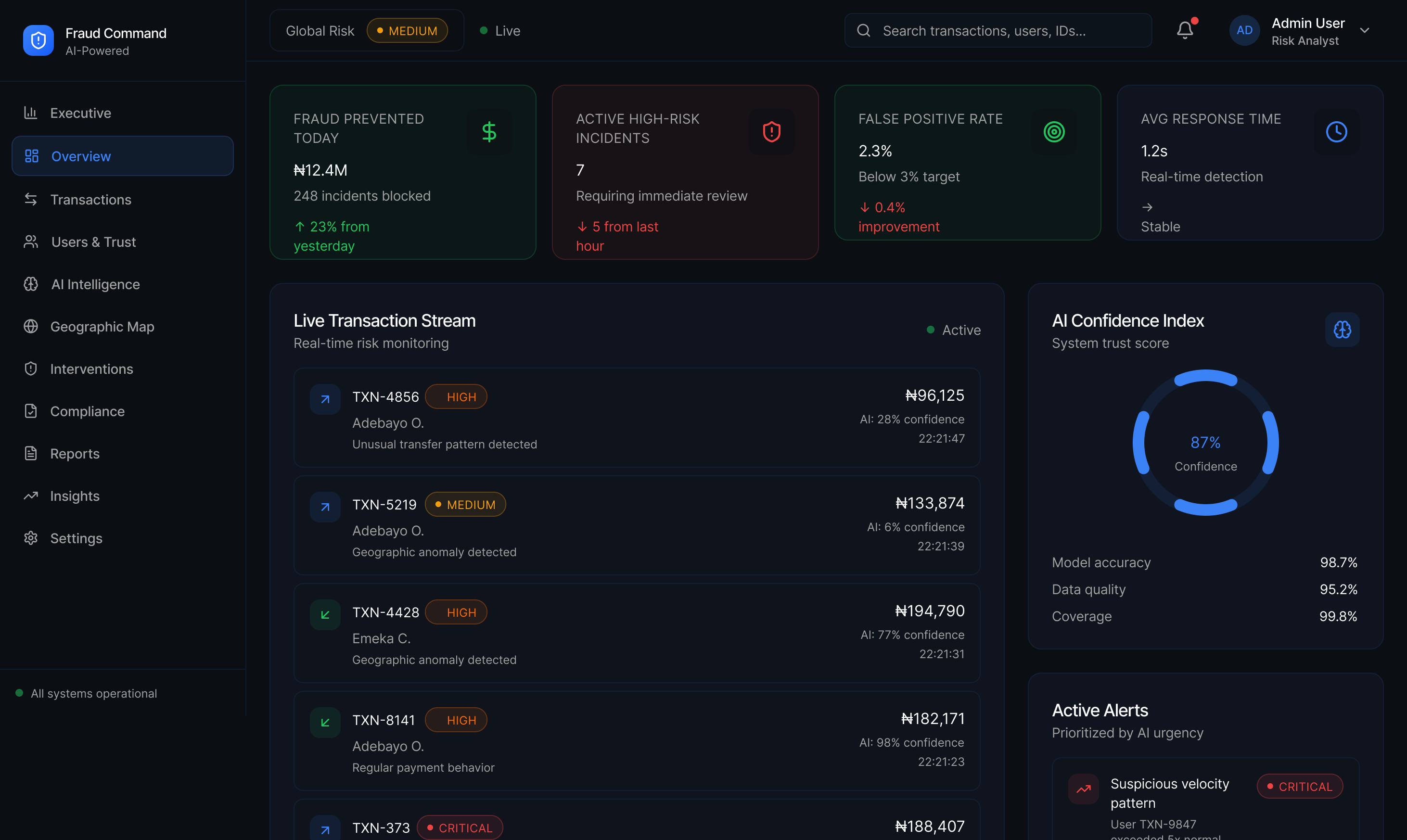
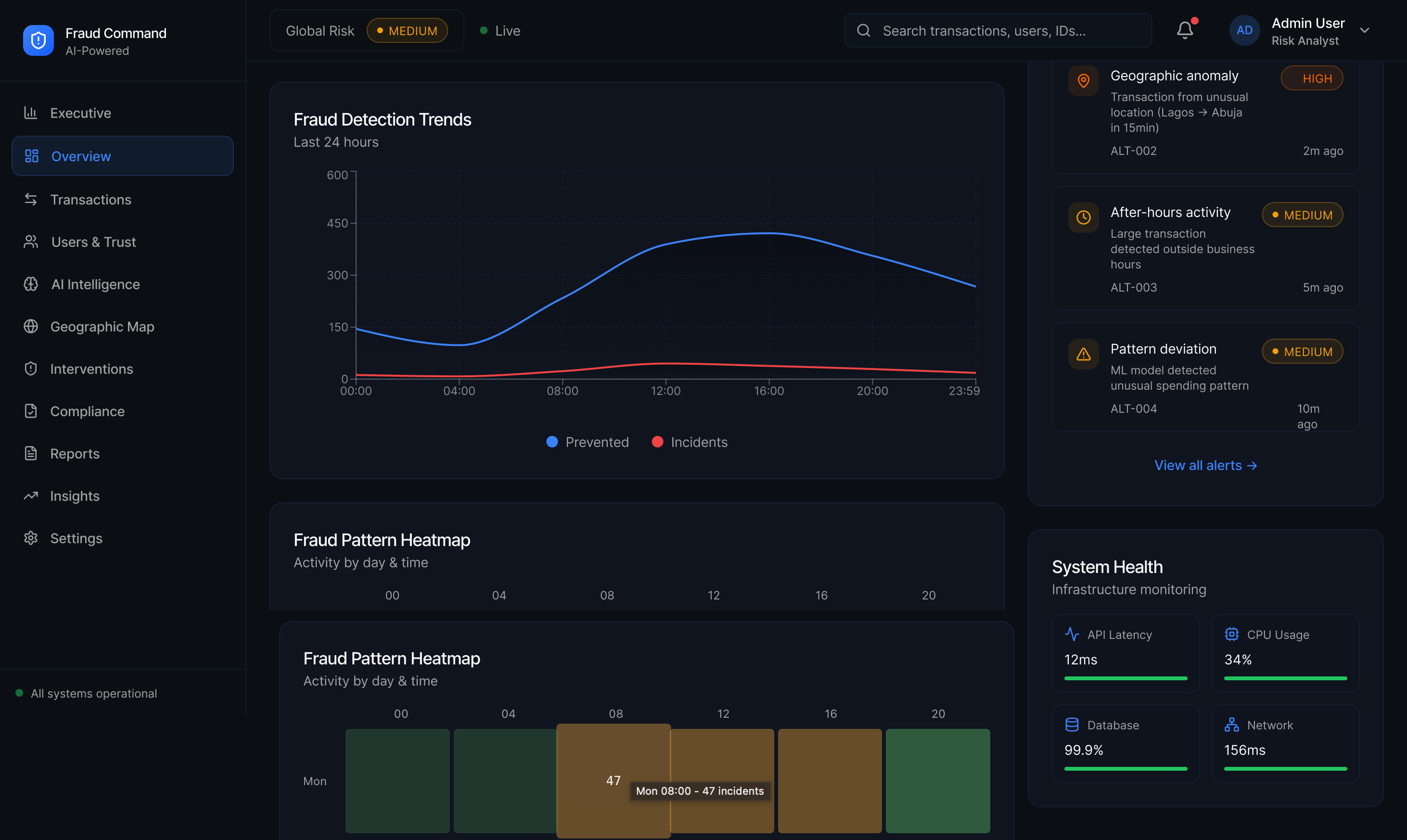
Overview Dashboard
✔ KPI cards: High-impact KPI cards (fraud prevented, active risks, response time, confidence index)
✔ Transactions: Live transaction stream with color-coded risk badges
✔ AI alerts: AI-powered alert prioritization with confidence explanations
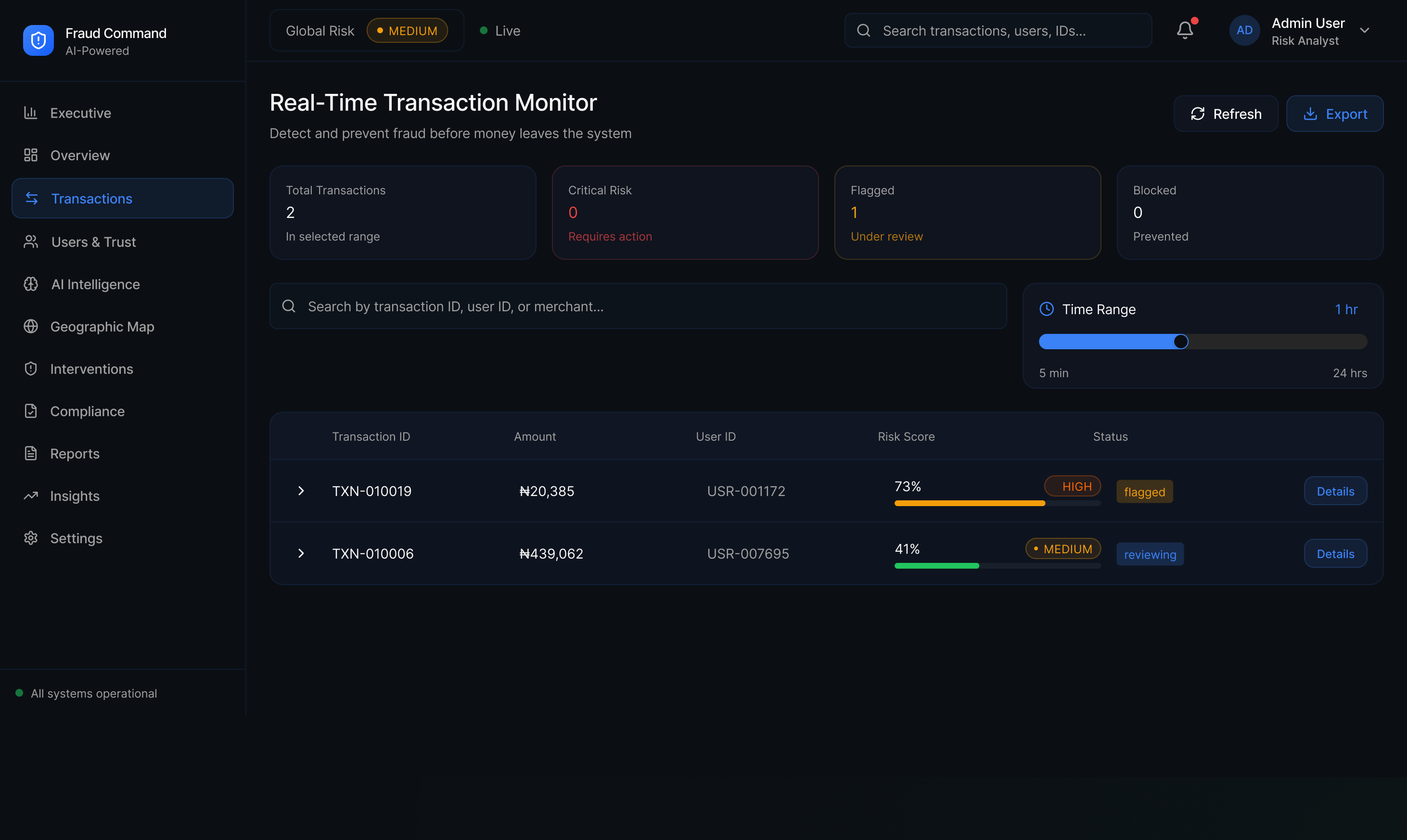
Real-Time Transaction Risk Monitor
✔ Risk score: Visual risk score indicators
✔ Recommendations: Side panel explaining why a transaction was flagged and recommended actions
✔ Time filter: Time-based filtering (5 minutes → 24 hours)
AI Fraud Pattern Intelligence
✔ Fraud network: Fraud cluster network visualizations
✔ Scam check: Emerging scam typologies
✔ AI insights: AI-generated insights with confidence levels
✔ Reasoning: Explainability panels answering - What changed? Why it matters? How to respond?
Human-Expert Review
✔ AI recommendation: Clear AI recommendations with evidence trails
✔ Analyst panel: Analyst decision panel with override options
✔ Audit: Full audit tagging (who, why, when)
Highlighted mockups
(Scroll to explore)
What we achieved
Outcomes and impact
The impact of these design changes became clear in how users interacted with the product day to day. By reducing steps and simplifying key flows, I helped make ordering noticeably faster and less mentally demanding.
The redesigned restock experience led to more consistent repeat orders, as users could quickly pick up where they left off without friction. Improving the product hierarchy and navigation also reduced confusion, making it easier for users to find what they needed with confidence.
I focused heavily on building trust by making order progress more transparent. Clearer order states helped both POCs and bulk-breakers understand exactly where their orders stood, reducing uncertainty and unnecessary follow-ups.
To support real-world usage, I strengthened error handling and offline awareness, which improved the reliability of the marketplace in challenging network conditions. Finally, by introducing consistent UI patterns, I helped align Kuja Shop more closely with the broader Kuja ecosystem, creating a more unified and scalable product experience.
Reflection
My takeaways
This project deeply reinforced how critical trust, clarity, and explainability are when designing AI-powered systems. Working in a high-stakes space like financial crime prevention showed me that great design goes far beyond visual polish, it’s about helping people make confident decisions, reducing cognitive load, and knowing when automation should step back to allow human judgment.
It also strengthened my belief in the intentional use of AI within the design process. When applied thoughtfully, AI doesn’t just make work faster, it adds depth, sharpens thinking, and allows more focus on solving the right problems.

harles


Copyright 2025 by Charles Nwafor

ShieldONE
Role
Product Designer
Project Type
AI Assisted Project
Industry
Fintech/Digital Banking
Year
Completed 2026
ShieldONE was designed as an enterprise-grade, desktop-first web application created to help fintech companies detect, predict, and prevent fraud before financial losses occur. Our design team worked closely to build a unified platform that could serve as a single source of truth for fraud, trust, risk, and compliance teams. The goal was to combine AI-driven intelligence with clear explainability and human oversight, enabling organizations to monitor threats and act decisively in real time.
In building this platform, we focused on the needs of fintech founders, executives, fraud analysts, risk and compliance teams, and payment operations managers. The experience was designed to give them immediate visibility into system health, emerging threats, and the impact of their interventions, enabling faster, more confident decision-making in high-stakes environments.The project was delivered through a collaborative effort between two product designers, a product manager, and the engineering team.

The part I played
My role
I worked as the lead product designer on ShieldONE, responsible for:
- From foundation to final UX and UI design
- Information architecture and dashboard structure
- Cross-functional collaboration with product, engineering, and risk stakeholders
- Designing AI explainability patterns and human-in-the-loop workflows
- Leveraging AI-assisted design tools to accelerate ideation and execution
The problem
As our team explored the problem space while working on ShieldONE, it quickly became clear that fraud detection in many fintech systems is still largely reactive. Through collaborative discovery sessions with the product manager, engineering team, and stakeholders, we uncovered a recurring pattern: by the time suspicious activity is reviewed, the money has often already left the system. This meant that many teams were operating in damage-control mode rather than actively preventing fraud.
During research and internal discussions, I also identified how fragmented the existing workflows were. Fraud and risk teams frequently had to switch between multiple tools, dashboards, and reports just to piece together a single incident. Together with the PM and engineering team, I mapped these workflows and saw how this fragmentation slowed response times, increased false positives, and created unnecessary friction for legitimate users.
Another major challenge was trust. Limited AI explainability made it difficult for teams to understand or confidently act on automated decisions. High-risk incidents took too long to resolve, false positives disrupted real customers, and compliance reporting was often manual, time-consuming, and stressful especially during audits.
These challenges highlighted the need for a single, proactive system that could bring visibility, speed, and trust back into fraud prevention workflows.
The goal
When defining the design goal for ShieldONE, I set out to create a real-time, AI-powered command center that could stop fraud before transactions were completed-not after the damage was done. I wanted every AI-driven decision to be clear and explainable, so teams could understand why something was flagged and act with confidence.
My focus was on enabling fast, decisive human intervention without overwhelming users with complexity. At the same time, the system needed to support regulatory readiness at all times, reducing the stress and overhead of compliance.
Finally, I designed the experience to give executives instant, high-level clarity so they could quickly understand system health, emerging risks, and the impact of decisions without diving into operational details.
ShieldONE
AI-Powered FCC

AI-assisted design workflow
AI support
A core part of my approach on ShieldONE was intentionally using AI to accelerate and strengthen the design process. As team lead, I treated AI as a design multiplier helping us explore more ideas, test assumptions faster, and make more informed decisions throughout the product development cycle.
Through prompt-driven ideation, I rapidly explored dashboard layouts, information hierarchies, and data visualization concepts, generating early concepts and iterating quickly before committing to a direction. I also used AI to refine copy and microcopy for clarity across complex workflows.
Beyond visuals, I leveraged AI to simulate scenarios and stress-test edge cases, allowing me to move faster from concept to validation and focus more on system thinking, UX quality, and decision-making without compromising design standards.
Initial AI Concepts(Scroll to explore)
Design process
Design direction
I began by mapping the full fraud lifecycle, from transaction initiation to post-incident reporting, and speaking with stakeholders to understand how different teams think and work. Executives needed clarity without noise, analysts needed depth and control, and compliance teams needed traceability and audit-ready outputs.
These insights led me to design ShieldONE as a multi-layered system rather than a single dashboard. I created role-based views ranging from a high-level command center to live risk monitoring, human-in-the-loop reviews, and compliance reporting while maintaining a shared data foundation. Throughout, I focused on balancing dense real-time data with clarity and scannability to support fast, confident decisions.
Executive Snapshot
✔ KPI cards: High-impact KPI cards (fraud prevented, active risks, response time, confidence index)
✔ Fraud forecast: Compare actual and forecasted fraud prevented
✔ Confidence score: System confidence score for fraud detection, accuracy and data quality.
✔ Key insights: Insights on performance, number of threats, compliance and trend direction.
Overview Dashboard
✔ KPI cards: High-impact KPI cards (fraud prevented, active risks, response time, confidence index)
✔ Transactions: Live transaction stream with color-coded risk badges
✔ AI alerts: AI-powered alert prioritization with confidence explanations
Real-Time Transaction Risk Monitor
✔ Risk score: Visual risk score indicators
✔ Recommendations: Side panel explaining why a transaction was flagged and recommended actions
✔ Time filter: Time-based filtering (5 minutes → 24 hours)
AI Fraud Pattern Intelligence
✔ Fraud network: Fraud cluster network visualizations
✔ Scam check: Emerging scam typologies
✔ AI insights: AI-generated insights with confidence levels
✔ Reasoning: Explainability panels answering - What changed? Why it matters? How to respond?
Human-Expert Review
✔ AI recommendation: Clear AI recommendations with evidence trails
✔ Analyst panel: Analyst decision panel with override options
✔ Audit: Full audit tagging (who, why, when)
Highlighted mockups
What we achieved
Outcomes and impact
The impact of ShieldONE became clear in how teams could finally work from a single, shared view of fraud, risk, and compliance. By bringing everything into one operational command center, I helped eliminate fragmentation and make real-time decision-making possible.
Real-time monitoring and quick, one-click actions significantly reduced response times by an average of 89%, allowing teams to intervene before issues escalated. By making AI decisions more transparent and explainable, I also helped build trust so users could understand, validate, and confidently act on automated insights.
For executives, I designed clear, high-level views that provided instant clarity without operational noise, improving confidence to over 90% in both the system and the decisions being made. Underneath it all, I established a scalable foundation that can adapt to different fintech products, risk profiles, and regulatory environments as the platform evolves.
Reflection
My takeaways
This project deeply reinforced how critical trust, clarity, and explainability are when designing AI-powered systems. Working in a high-stakes space like financial crime prevention showed me that great design goes far beyond visual polish, it’s about helping people make confident decisions, reducing cognitive load, and knowing when automation should step back to allow human judgment.
It also strengthened my belief in the intentional use of AI within the design process. When applied thoughtfully, AI doesn’t just make work faster, it adds depth, sharpens thinking, and allows more focus on solving the right problems.THANK YOU.
harles
Copyright 2025 by Charles Nwafor
ShieldONE
Role
Product Designer
Project Type
AI Assisted Project
Industry
Fintech/Digital Banking
Timeline
Completed 2026
ShieldONE was designed as an enterprise-grade, desktop-first web application created to help fintech companies detect, predict, and prevent fraud before financial losses occur. Our design team worked closely to build a unified platform that could serve as a single source of truth for fraud, trust, risk, and compliance teams. The goal was to combine AI-driven intelligence with clear explainability and human oversight, enabling organizations to monitor threats and act decisively in real time.
In building this platform, we focused on the needs of fintech founders, executives, fraud analysts, risk and compliance teams, and payment operations managers. The experience was designed to give them immediate visibility into system health, emerging threats, and the impact of their interventions, enabling faster, more confident decision-making in high-stakes environments.The project was delivered through a collaborative effort between two product designers, a product manager, and the engineering team.

The part I played
My role
I worked as the lead product designer on ShieldONE, responsible for:
- From foundation to final UX and UI design
- Information architecture and dashboard structure
- Cross-functional collaboration with product, engineering, and risk stakeholders
- Designing AI explainability patterns and human-in-the-loop workflows
- Leveraging AI-assisted design tools to accelerate ideation and execution
The problem
As our team explored the problem space while working on ShieldONE, it quickly became clear that fraud detection in many fintech systems is still largely reactive. Through collaborative discovery sessions with the product manager, engineering team, and stakeholders, we uncovered a recurring pattern: by the time suspicious activity is reviewed, the money has often already left the system. This meant that many teams were operating in damage-control mode rather than actively preventing fraud.
During research and internal discussions, I also identified how fragmented the existing workflows were. Fraud and risk teams frequently had to switch between multiple tools, dashboards, and reports just to piece together a single incident. Together with the PM and engineering team, I mapped these workflows and saw how this fragmentation slowed response times, increased false positives, and created unnecessary friction for legitimate users.
Another major challenge was trust. Limited AI explainability made it difficult for teams to understand or confidently act on automated decisions. High-risk incidents took too long to resolve, false positives disrupted real customers, and compliance reporting was often manual, time-consuming, and stressful especially during audits.
These challenges highlighted the need for a single, proactive system that could bring visibility, speed, and trust back into fraud prevention workflows.
The goal
When defining the design goal for ShieldONE, I set out to create a real-time, AI-powered command center that could stop fraud before transactions were completed-not after the damage was done. I wanted every AI-driven decision to be clear and explainable, so teams could understand why something was flagged and act with confidence.
My focus was on enabling fast, decisive human intervention without overwhelming users with complexity. At the same time, the system needed to support regulatory readiness at all times, reducing the stress and overhead of compliance.
Finally, I designed the experience to give executives instant, high-level clarity so they could quickly understand system health, emerging risks, and the impact of decisions without diving into operational details.
ShieldONE
AI-Powered FCC

AI-assisted design workflow
AI support
A core part of my approach on ShieldONE was intentionally using AI to accelerate and strengthen the design process. As team lead, I treated AI as a design multiplier helping us explore more ideas, test assumptions faster, and make more informed decisions throughout the product development cycle.
Through prompt-driven ideation, I rapidly explored dashboard layouts, information hierarchies, and data visualization concepts, generating early concepts and iterating quickly before committing to a direction. I also used AI to refine copy and microcopy for clarity across complex workflows.
Beyond visuals, I leveraged AI to simulate scenarios and stress-test edge cases, allowing me to move faster from concept to validation and focus more on system thinking, UX quality, and decision-making without compromising design standards.
Initial AI Concepts(Scroll to explore)
Design process
Design direction
I began by mapping the full fraud lifecycle, from transaction initiation to post-incident reporting, and speaking with stakeholders to understand how different teams think and work. Executives needed clarity without noise, analysts needed depth and control, and compliance teams needed traceability and audit-ready outputs.
These insights led me to design ShieldONE as a multi-layered system rather than a single dashboard. I created role-based views ranging from a high-level command center to live risk monitoring, human-in-the-loop reviews, and compliance reporting while maintaining a shared data foundation. Throughout, I focused on balancing dense real-time data with clarity and scannability to support fast, confident decisions.
Executive Snapshot
✔ KPI cards: High-impact KPI cards (fraud prevented, active risks, response time, confidence index)
✔ Fraud forecast: Compare forecasted and actual fraud prevented.
✔ Confidence score: System confidence score for fraud detection, accuracy and data quality.
✔ Key insights: Insights on performance, number of threats, compliance and trend direction.
Overview Dashboard
✔ KPI cards: High-impact KPI cards (fraud prevented, active risks, response time, confidence index)
✔ Transactions: Live transaction stream with color-coded risk badges
✔ AI alerts: AI-powered alert prioritization with confidence explanations
Real-Time Transaction Risk Monitor
✔ Risk score: Visual risk score indicators
✔ Recommendations: Side panel explaining why a transaction was flagged and recommended actions
✔ Time filter: Time-based filtering (5 minutes → 24 hours)
AI Fraud Pattern Intelligence
✔ Fraud network: Fraud cluster network visualizations
✔ Scam check: Emerging scam typologies
✔ AI insights: AI-generated insights with confidence levels
✔ Reasoning: Explainability panels answering - What changed? Why it matters? How to respond?
Human-Expert Review
✔ AI recommendation: Clear AI recommendations with evidence trails
✔ Analyst panel: Analyst decision panel with override options
✔ Audit: Full audit tagging (who, why, when)
Highlighted mockups
What we achieved
Outcomes and impact
The impact of ShieldONE became clear in how teams could finally work from a single, shared view of fraud, risk, and compliance. By bringing everything into one operational command center, I helped eliminate fragmentation and make real-time decision-making possible.
Real-time monitoring and quick, one-click actions significantly reduced response times by an average of 89%, allowing teams to intervene before issues escalated. By making AI decisions more transparent and explainable, I also helped build trust so users could understand, validate, and confidently act on automated insights.
For executives, I designed clear, high-level views that provided instant clarity without operational noise, improving confidence to over 90% in both the system and the decisions being made. Underneath it all, I established a scalable foundation that can adapt to different fintech products, risk profiles, and regulatory environments as the platform evolves.
Reflection
My takeaways
This project deeply reinforced how critical trust, clarity, and explainability are when designing AI-powered systems. Working in a high-stakes space like financial crime prevention showed me that great design goes far beyond visual polish, it’s about helping people make confident decisions, reducing cognitive load, and knowing when automation should step back to allow human judgment.
It also strengthened my belief in the intentional use of AI within the design process. When applied thoughtfully, AI doesn’t just make work faster, it adds depth, sharpens thinking, and allows more focus on solving the right problems.THANK YOU.
Other projects
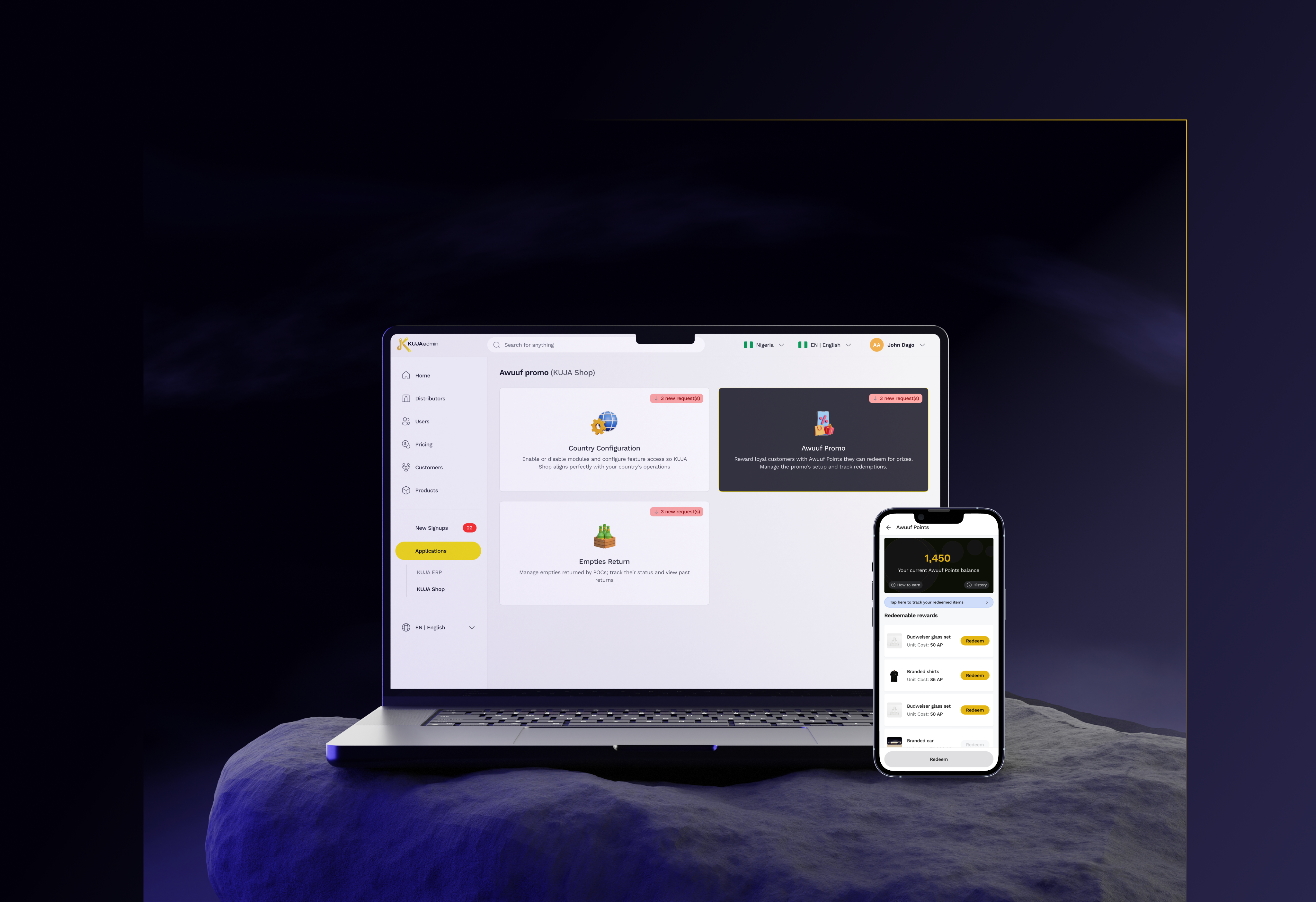
KUJA Awuuf
Kuja Awuuf app feature
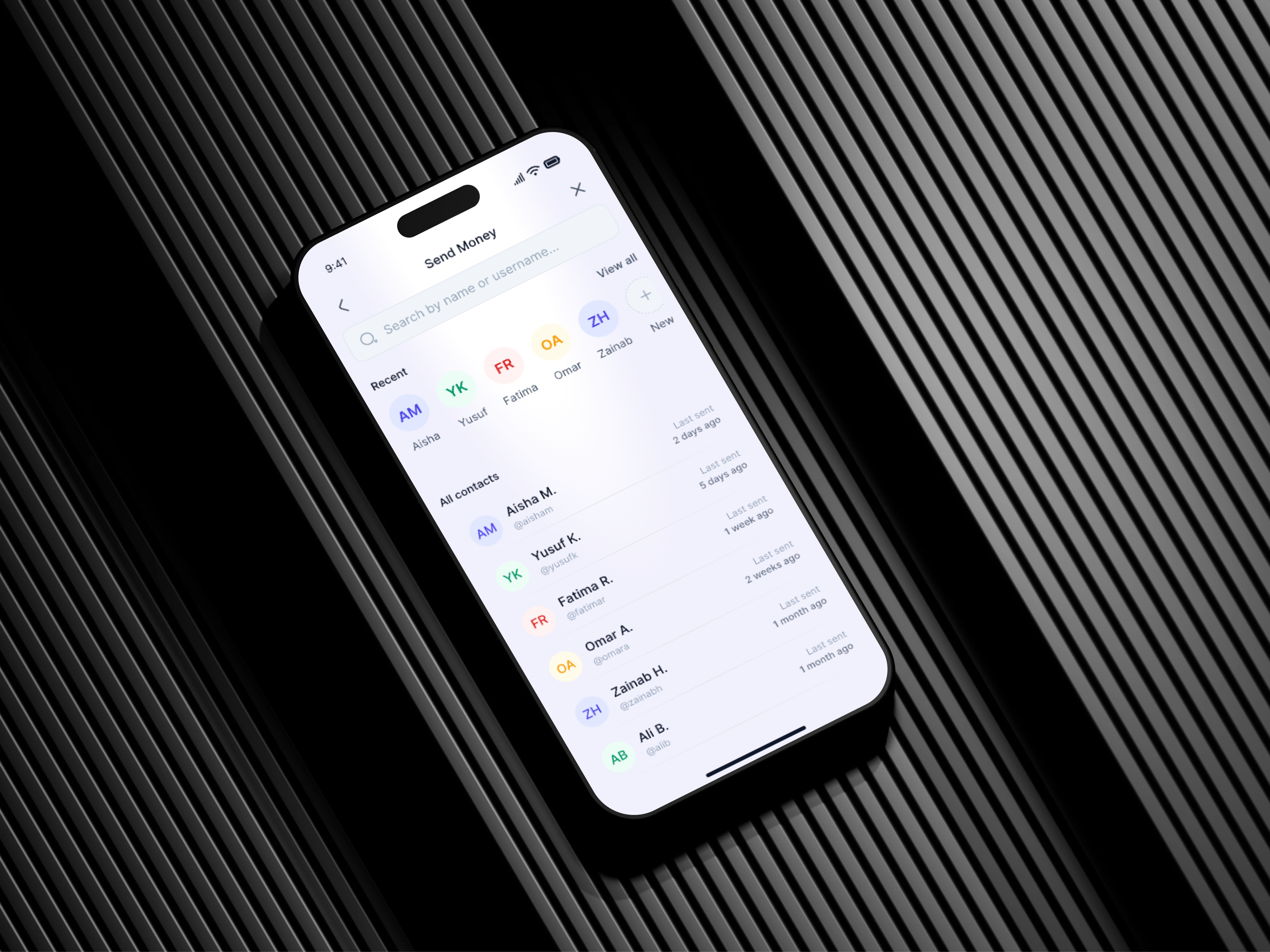
MAL mobile app
AI Gave Me a Blueprint. The Design Was Mine
harles
Copyright 2025 by Charles Nwafor